
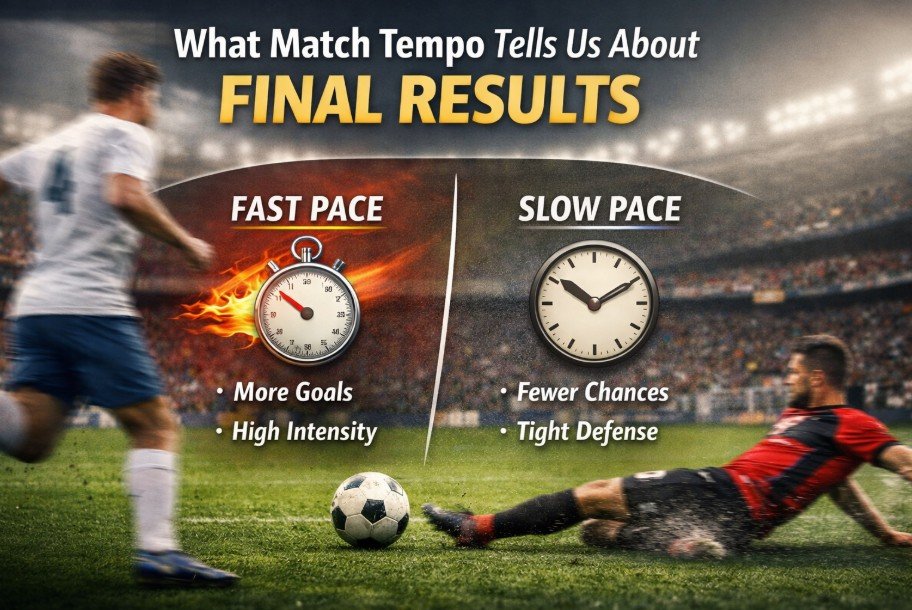
Football is often talked about in terms of goals, possession, and star players. But there’s another layer that quietly shapes how games unfold: match tempo. Tempo is not always obvious on the stat sheet, yet it plays a major role in deciding whether a match ends in a draw, a narrow win, or a goal-fest.
In simple terms, match tempo refers to how fast or slow a game is played. Once you understand it, you start seeing patterns that many fans and even casual bettors overlook. This article breaks down what match tempo really means, how to spot it, and what it can tell us about final results.
What Is Match Tempo in Football?
Match tempo is the speed and rhythm of a football game. It’s about how quickly teams move the ball, how often play is stopped, and how intense the overall pace feels.
A high-tempo match usually features:
-
Quick passing and fast transitions
-
High pressing and constant movement
-
Frequent attacks and counterattacks
A low-tempo match, on the other hand, tends to include:
-
Slower build-up play
-
More sideways or backward passes
-
Fewer shots and longer pauses in play
Tempo is not the same as possession. A team can have a lot of the ball but still play at a slow tempo.
Why Match Tempo Matters for Final Results
Tempo shapes how many chances are created and who controls the match. When the tempo stays consistent, results often follow predictable patterns.
-
High tempo increases randomness. Mistakes happen more often, defences get stretched, and goals are more likely.
-
Low tempo reduces risk. Teams stay compact, chances are limited, and draws become more common.
Understanding this helps explain why some matches feel “open” while others feel locked from kickoff.
High-Tempo Matches: What They Usually Lead To
More Goals, More Chaos
Fast games usually produce:
-
Higher shot counts
-
More defensive errors
-
Late goals due to fatigue
This is common in leagues where pressing and quick transitions are part of the football culture. When both teams buy into the pace, matches often swing back and forth.
Less Control for Favorites
High tempo doesn’t always favor the stronger team. In fact, underdogs often benefit because:
-
Structure breaks down
-
Individual mistakes increase
-
Matches become more unpredictable
That’s why strong favorites sometimes drop points in fast, open games.
Low-Tempo Matches: A Different Story
Why Draws Are Common
Slow matches often end level because:
-
Teams prioritize shape over risk
-
Few clear chances are created
-
One goal can completely change tactics
You’ll see this a lot in:
-
Tactical leagues
-
Derby matches
-
Games where both teams are happy with a point
Narrow Wins Instead of Blowouts
When goals do come in low-tempo games, they’re often:
-
Set-piece goals
-
Deflections
-
Individual moments of quality
Big scorelines are rare because there simply aren’t enough chances.
How Teams Control Tempo
Tactical Setup
Coaches decide tempo before the first whistle:
-
A deep defensive line slows the game
-
High pressing speeds it up
-
Extra midfielders usually reduce tempo
Formations like 4-5-1 or 5-3-2 often signal caution, while 4-3-3 and 3-4-3 tend to push the pace.
Match Context
Tempo also changes depending on:
-
League position
-
Match importance
-
First-leg vs second-leg fixtures
A team chasing points late in the season will naturally play faster than one protecting a comfortable table position.
In-Game Signs That Reveal Match Tempo
You don’t need advanced data to read tempo. Watching carefully is often enough.
Early Indicators (First 15–20 Minutes)
Look for:
-
Speed of throw-ins and free kicks
-
Number of long balls forward
-
How quickly teams reset after losing possession
These early moments often set the rhythm for the entire match.
Referee Influence
Some referees allow physical play and quick restarts, which raises tempo. Others stop play frequently, slowing everything down. This is an often-overlooked factor.
Tempo Shifts During a Match
Matches rarely stay the same from start to finish.
What Changes Tempo?
-
A goal (especially an early one)
-
A red card
-
Tactical substitutions
A slow match can suddenly open up after a goal, while a fast match may slow down once a team takes the lead.
Why Late Goals Happen
High-tempo games often produce late goals because:
-
Players get tired
-
Defensive concentration drops
-
Space opens up
In contrast, low-tempo games may stay tight until the final whistle.
Match Tempo vs Statistics: Why Context Matters
Raw stats don’t always tell the full story.
For example:
-
60% possession in a slow match may mean very little threat
-
40% possession in a fast match can still create many chances
Tempo helps explain why similar stats lead to different results across matches.
Using Match Tempo to Read Games Better
Whether you’re a fan or someone who studies matches closely, understanding tempo improves how you interpret football.
It helps you:
-
Understand why a match feels “dead” or “open”
-
See why certain games end in draws
-
Recognize when a result is likely to change late
Instead of focusing only on goals or shots, tempo adds an extra layer of insight.
Conclusion.
Match tempo is one of the most underrated aspects of football analysis. It doesn’t replace other factors like team quality or tactics, but it connects them in a meaningful way.
Fast matches tend to bring goals and surprises. Slow matches often bring control, tension, and draws. Once you start paying attention to tempo, match results stop feeling random and start making more sense.
Football isn’t just about who plays better, it’s also about how fast the game is allowed to breathe.