
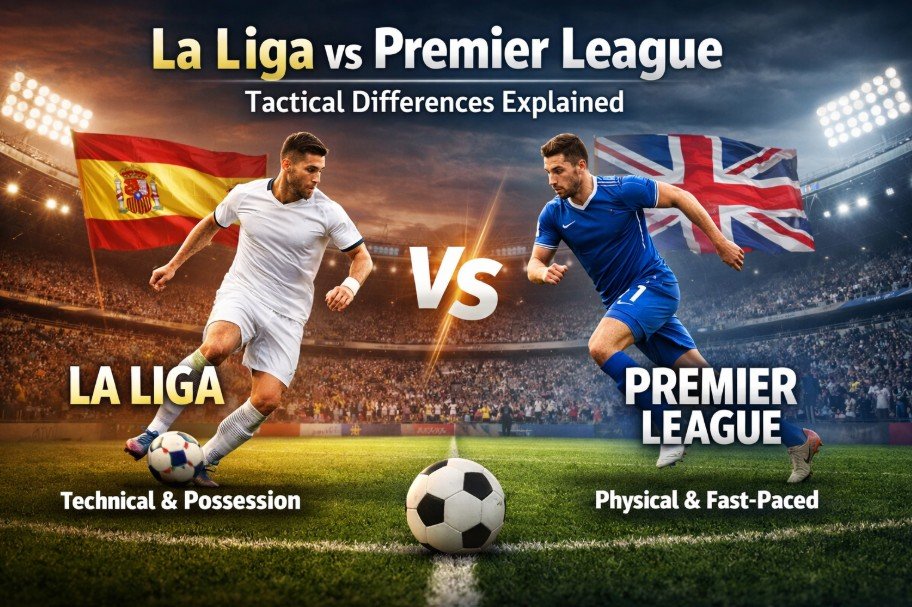
Football fans often argue about which league is better: Spain’s La Liga or England’s Premier League. Some love the technical beauty of Spanish football, while others prefer the speed and power of the English game. But beyond results and star players, the real difference lies in tactics and playing philosophy.
Both leagues produce world-class football, yet they approach the game in very different ways. In this article, we’ll break down how La Liga and the Premier League differ tactically, using simple language and real football logic to explain what makes each style unique.
The Football Culture Behind Each League
Before diving into tactics, it’s important to understand the football culture that shapes them.
La Liga’s Technical Identity
Spanish football is built around control, intelligence, and technical quality. From youth level, players are trained to keep the ball, stay calm under pressure, and make smart positional decisions. Teams focus on:
-
Short passing
-
Positional play
-
Patience in attack
-
Intelligent movement
Rather than rushing forward, La Liga sides prefer to build slowly, waiting for spaces to appear.
Premier League’s Physical and Fast Style
The Premier League developed with a different mindset. English football values tempo, strength, and directness. Matches are usually played at a high speed, with more transitions and physical battles. Key ideas include:
-
Fast attacking moves
-
Strong pressing
-
High intensity
-
Direct vertical play
Instead of controlling the game slowly, Premier League teams often try to win it through speed and aggression.
This cultural base explains many tactical differences we see on the pitch.
Build-Up Play: Patience vs Pace
One of the biggest tactical contrasts is how teams move the ball from defense to attack.
How La Liga Teams Build Attacks
In La Liga, build-up play is usually slow and structured. Defenders and midfielders recycle possession until the right moment appears. You’ll often see:
-
Goalkeepers involved in passing
-
Center-backs splitting wide
-
Midfielders dropping deep
-
Short passing triangles
Teams aim to drag opponents out of position before attacking. Instead of forcing the ball forward, they value ball security and positional discipline.
This makes La Liga games look calmer and more technical.
How Premier League Teams Progress the Ball
In the Premier League, build-up is more vertical and aggressive. Teams look to attack space quickly. Common patterns include:
-
Long passes behind defenders
-
Quick switches of play
-
Early crosses
-
Fast counterattacks
Rather than waiting, Premier League sides try to exploit gaps immediately. This creates end-to-end football and more chaotic situations compared to Spain’s structured style.
Pressing and Defensive Shape
Defending is another area where both leagues differ tactically.
La Liga’s Intelligent Pressing
La Liga teams press in a compact and organized way. Instead of sprinting constantly, they focus on positioning:
-
Closing passing lanes
-
Controlling zones
-
Forcing mistakes through shape
-
Staying close between defense and midfield
Pressing is more about collective movement than pure energy. Players wait for triggers before stepping forward, keeping the team balanced.
This makes Spanish defenses harder to break down with simple long balls.
Premier League’s High-Intensity Press
In England, pressing is often more aggressive and physical. Teams push high up the pitch and attack the ball carrier fast. You’ll notice:
-
Full-backs pressing high
-
Forwards chasing defenders
-
Midfielders tackling aggressively
-
Quick defensive transitions
The goal is to win the ball early and attack immediately. While effective, it can also leave space behind the defense, leading to more open matches.
That’s why Premier League games often feel faster and less predictable.
Midfield Control vs Midfield Battles
The midfield is where tactics truly come alive.
La Liga’s Positional Midfield
Spanish teams treat midfield as the brain of the team. The focus is on:
-
Ball retention
-
Spatial awareness
-
Passing rhythm
-
Intelligent rotations
Midfielders rarely rush. They scan, pass, move, and repeat. The idea is to dominate possession and control the tempo of the game.
Instead of physical duels, La Liga midfielders rely more on technical superiority and positioning.
Premier League’s Physical Midfield Play
In the Premier League, midfield is more of a battle zone. Players are expected to combine technique with power:
-
Strong tackles
-
Box-to-box running
-
Fast ball recovery
-
Vertical passes
Midfielders cover more ground and engage in frequent challenges. Possession matters, but winning second balls and transitions is just as important.
This makes Premier League midfields more energetic and less patient compared to La Liga’s calmer control.
Attacking Patterns and Chance Creation
How teams create chances also reflects their tactical identity.
La Liga’s Structured Attacks
In La Liga, attacks are often planned and positional. Teams move as a unit and look for:
-
Through balls between lines
-
Overloads on the wings
-
Cut-backs inside the box
-
Combination play
Crossing exists, but it’s not the main weapon. Instead, teams prefer to work the ball into dangerous areas using movement and short passes.
This leads to fewer rushed shots and more carefully constructed chances.
Premier League’s Direct Attacks
Premier League teams attack with more speed and variety. Common attacking tools include:
-
Early crosses
-
Quick counters
-
Long shots
-
Fast breaks after turnovers
Instead of waiting for perfect positioning, teams often attack immediately. This produces more shots, more transitions, and more chaotic moments in the box.
It’s exciting, but also riskier than La Liga’s controlled approach.
Game Management and Tempo Control
Another tactical difference is how teams manage matches.
La Liga’s Tempo Control
Spanish sides care deeply about game rhythm. When leading, they slow things down:
-
Holding possession
-
Drawing fouls
-
Reducing transitions
-
Controlling space
The idea is to protect results with intelligence rather than physical effort.
Premier League’s Relentless Tempo
In the Premier League, even winning teams often keep attacking. The tempo rarely drops:
-
High pressing continues
-
Full-backs still push forward
-
Matches remain open
-
Transitions stay fast
This leads to dramatic late goals and constant action, but also makes games harder to control tactically.
Which Style Works Better?
There is no perfect answer. Both styles succeed in different ways.
La Liga excels in:
-
Tactical discipline
-
Technical quality
-
Game control
-
Positional intelligence
The Premier League shines in:
-
Speed and intensity
-
Physical strength
-
Transition football
-
Entertainment value
Spanish football is about thinking the game, while English football is about feeling the game at full speed.
When these styles meet in Europe, the clash between control and chaos often decides the result.
Conclusion
La Liga and the Premier League may share the same rules, but they speak different football languages. La Liga focuses on patience, positioning, and technical mastery. The Premier League emphasizes pace, power, and direct action.
Understanding these tactical differences helps fans read matches better, predict styles of play, and appreciate why games in Spain feel calm and calculated, while games in England feel fast and unpredictable.
In the end, both leagues offer something special. One teaches you how football should be controlled. The other shows you how football can explode with energy. And that contrast is what keeps the global game exciting.