
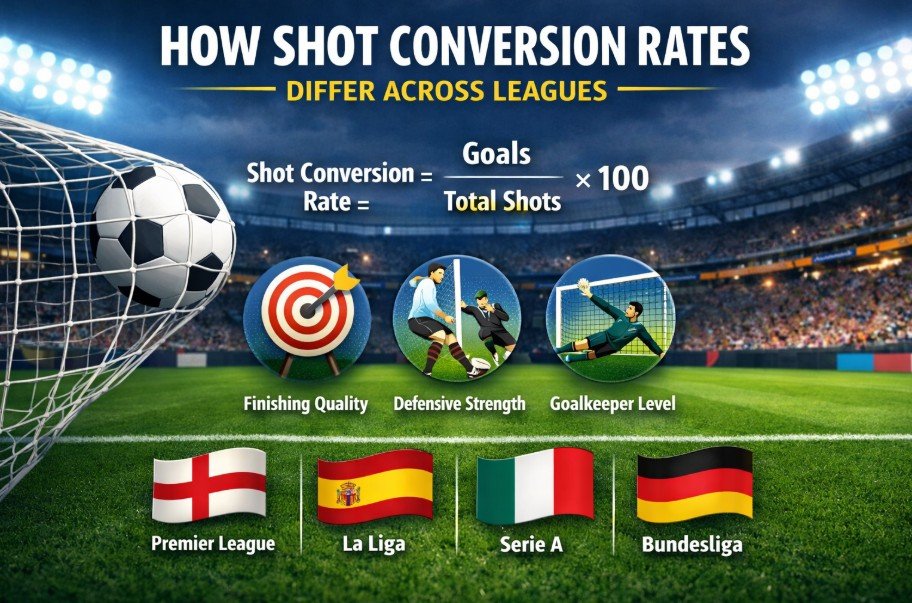
In football, goals decide everything – but goals start with shots. One of the most useful ways to understand how teams and leagues really perform is by looking at shot conversion rate. Simply put, it measures how many shots turn into goals.
Some leagues create lots of chances but waste them. Others may not shoot as often, but when they do, they score. These differences tell a deeper story about playing styles, defensive strength, player quality, and even refereeing standards.
In this article, we’ll break down what shot conversion rate means, why it matters, and how it varies across major football leagues around the world – in simple, practical terms.
What Is Shot Conversion Rate?
Shot conversion rate shows the percentage of shots that end up as goals.
Basic Formula
Shot Conversion Rate = (Goals ÷ Total Shots) × 100
For example:
If a team takes 100 shots and scores 12 goals, their conversion rate is 12%.
This tells us more than just how attacking a team is. It shows how efficient they are in front of goal.
Why Shot Conversion Rates Matter
A league can have plenty of shots per game, but that doesn’t always mean plenty of goals. Conversion rates help explain why.
Here’s what they reveal:
-
Finishing quality – Are players calm and accurate?
-
Defensive pressure – How hard is it to get clean shots?
-
Goalkeeper level – Strong keepers reduce conversion.
-
Tactical style – Some leagues favor careful buildup, others quick attacks.
-
Shot selection – Are players shooting from good positions or long range?
When you compare leagues, conversion rate helps separate chaos from control.
How Playing Style Affects Conversion
Not all shots are equal. A tap-in and a 30-yard strike both count as shots, but one is far more likely to become a goal.
Leagues differ in how chances are created.
Possession-Based Leagues
These leagues build patiently, looking for high-quality chances inside the box.
-
More cutbacks
-
More one-on-ones
-
Fewer speculative shots
That usually leads to higher conversion rates.
Direct or Physical Leagues
Here, teams attack faster and shoot earlier.
-
More crosses
-
More long-range efforts
-
More crowded penalty areas
This often produces lower conversion, even with many attempts.
So style plays a big role before finishing ability even comes into play.
Shot Conversion in Top European Leagues
Let’s look at how major leagues tend to behave when it comes to converting shots.
Premier League (England)
The Premier League is fast, physical, and aggressive.
-
High tempo
-
Lots of shots per match
-
Heavy defensive pressure
Because defenders close down quickly and goalkeepers are strong, many shots are contested. That slightly lowers conversion compared to slower leagues, even though the talent is elite.
You’ll often see many attempts but fewer “easy” finishes.
La Liga (Spain)
La Liga is known for technical control and patient buildup.
-
Better spacing
-
Cleaner final passes
-
More shots inside the box
This usually results in strong conversion numbers. Teams focus on working the ball into good positions rather than shooting early.
Spanish attackers tend to take fewer shots, but from better areas.
Serie A (Italy)
Serie A is tactical and structured.
-
Compact defenses
-
Fewer open chances
-
High shot discipline
Because chances are harder to come by, finishing quality matters more. When shots do arrive, they’re often from planned movements, giving Serie A a fairly efficient conversion profile despite fewer total shots.
Bundesliga (Germany)
The Bundesliga is open and attacking.
-
High pressing
-
Fast transitions
-
Many counter-attacks
This creates plenty of shots, especially in broken play. Because many attempts come at speed, conversion can fluctuate. Some matches explode with goals, while others see lots of wasted chances.
Overall, the league mixes volume with efficiency better than most.
Ligue 1 (France)
Ligue 1 balances physical power with technical skill.
-
Strong athletes
-
Fewer but sharper chances
-
Good goalkeeping
Top teams convert well, but mid-table sides sometimes struggle with consistency. That creates a league where conversion varies widely from club to club rather than staying uniform.
Shot Conversion Outside Europe
Conversion differences become even more visible when you look beyond Europe.
South American Leagues
Many South American leagues feature:
-
Tight pitches
-
Aggressive marking
-
Quick shooting
Players often take chances early, which increases shot volume but lowers conversion. However, individual skill can still push elite teams above average.
Scandinavian Leagues
These leagues usually have:
-
More open games
-
Less defensive compactness
-
Higher chance quality
That allows a surprisingly good conversion rate even without superstar attackers. Space matters just as much as talent.
African Leagues
In many African competitions:
-
Physical battles dominate
-
Long-range shots are common
-
Penalty-box congestion is heavy
That tends to reduce clean finishes, meaning conversion rates stay lower even when matches look exciting.
The Role of Defensive Quality
A big reason leagues differ in conversion is how well they defend.
Strong Defensive Leagues
-
Fewer clear shots
-
More blocked attempts
-
More pressure on shooters
This lowers conversion even for good attackers.
Loose Defensive Leagues
-
More space in the box
-
More rebounds
-
More one-touch finishes
Here, conversion climbs because shooters aren’t rushed.
So when you compare leagues, always remember: conversion is as much about defense as attack.
Goalkeepers Also Shape Conversion
You can’t talk about finishing without mentioning goalkeepers.
Leagues with:
-
Better reflex keepers
-
Strong positioning
-
Aggressive sweeping
naturally suppress shot conversion.
In contrast, leagues with less consistent goalkeeping see more shots sneak in, even from difficult angles.
That’s why two leagues with similar shooting styles can still show different conversion numbers.
Why Shot Volume Doesn’t Equal Goals
Many people assume more shots means more goals. In reality, shot quality beats shot quantity.
A team taking:
-
18 rushed shots
might score less than a team taking -
9 calm, well-built chances.
Leagues that encourage smarter shot selection usually outperform leagues that encourage shooting at every opportunity.
That’s the main reason conversion rate is more reliable than just shots per game.
How to Use Shot Conversion in Match Analysis
If you’re analyzing matches, conversion rate helps answer important questions:
-
Are teams wasteful or clinical?
-
Is a high-scoring run sustainable?
-
Do goals come from volume or efficiency?
-
Is a league defensive or open?
When a league shows high shots but low conversion, expect inconsistency.
When a league shows moderate shots and high conversion, expect stable scoring patterns.
It also helps avoid overrating teams that shoot a lot but rarely score.
Conclusion.
Shot conversion rate gives us a smarter way to understand football across leagues. It’s not just about how often teams shoot, but how well they use those shots.
Some leagues thrive on patience and precision. Others rely on speed and volume. Defensive structure, goalkeeper quality, and tactical culture all shape how efficiently goals are scored.
When you look beyond raw numbers and focus on conversion, you start seeing why certain leagues feel chaotic, others controlled, and some surprisingly efficient.
In the end, football isn’t about how many times you pull the trigger – it’s about how often the ball actually hits the net.