
Football betting has grown into a multi-billion-dollar industry, yet many fans don’t really understand how the numbers on the betting board are determined. When you see odds like 2.50 for a team to win or 3.20 for a draw, it might seem random. In reality, there’s a lot of careful calculation, research, and strategy behind those numbers. Let’s take a closer look at how bookmakers set football odds in a simple and easy-to-understand way.
Understanding the Basics of Odds
Before diving into how bookmakers set odds, it’s important to understand what odds represent. At their core, odds reflect the probability of an event happening, adjusted to include the bookmaker’s profit margin.
For example:
-
If a team is heavily favored to win, their odds might be low, such as 1.50. This implies a high probability of winning.
-
Conversely, an underdog might have odds of 5.00, reflecting a lower chance of success.
Bookmakers use odds to balance risk and reward, ensuring they make a profit regardless of the match outcome.
Step 1: Collecting Data and Statistics
The first step in setting football odds is collecting all available data. Bookmakers rely on:
-
Team form – How has the team performed in recent matches?
-
Head-to-head records – How have the two teams fared against each other historically?
-
Player statistics – Injuries, suspensions, and individual performance stats.
-
External factors – Weather, pitch conditions, home advantage, and even referee tendencies.
This data helps bookmakers create a baseline probability for each possible outcome.
Step 2: Calculating Probabilities
Once the data is collected, bookmakers calculate the likelihood of each outcome: home win, draw, or away win.
Let’s say a bookmaker analyzes a match between Team A and Team B:
-
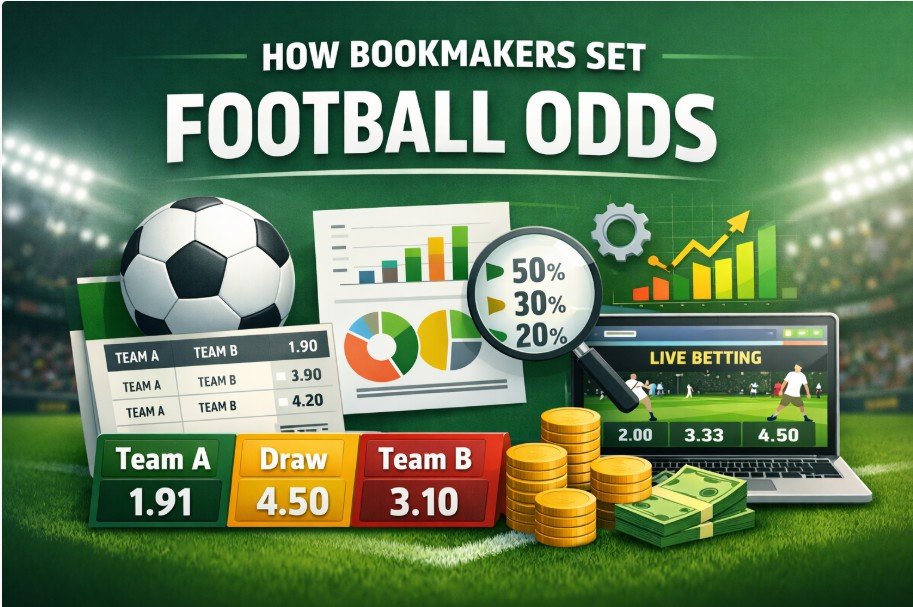
Team A has a 50% chance of winning
-
Team B has a 30% chance of winning
-
Draw has a 20% chance
These percentages represent the true probabilities. If we converted them into odds:
-
Team A win: 1 ÷ 0.50 = 2.00
-
Team B win: 1 ÷ 0.30 ≈ 3.33
-
Draw: 1 ÷ 0.20 = 5.00
At this stage, the odds reflect the expected probability without any profit margin.
Step 3: Adding the Bookmaker’s Margin
Bookmakers don’t operate as charities—they need to make a profit. That’s why they add a margin (also called an overround) to the odds.
Using the previous example:
-
Team A win: 2.00 → 1.91
-
Team B win: 3.33 → 3.10
-
Draw: 5.00 → 4.50
This adjustment ensures that if money is evenly placed across all outcomes, the bookmaker still makes a profit. This is how the odds you see at a betting site are slightly lower than the “true” probability would suggest.
Step 4: Considering Market Influence
Odds aren’t static—they change based on how the public bets. Bookmakers track the volume and distribution of bets and adjust accordingly:
-
If a lot of money is placed on one team, the bookmaker may lower its odds to reduce potential liability.
-
Conversely, odds for the other team may increase to attract bets and balance exposure.
This is why you might see odds fluctuate in the hours leading up to a match. It’s not just about statistics it’s also about managing risk and ensuring the bookmaker stays profitable.
Step 5: Using Expert Opinions and Algorithms
Modern bookmakers combine traditional data analysis with algorithms and AI models. These systems can quickly process large amounts of data—team news, player injuries, match conditions, and even social media sentiment—to refine the odds.
Some bookmakers also employ football experts to make qualitative adjustments. For instance:
-
A star striker might be returning from injury and may not be match-fit.
-
A team might have internal issues not visible in stats, like a change in management.
These factors can subtly influence the final odds.
Step 6: Offering Specials and Promotions
Finally, odds aren’t just about accuracy—they’re also a marketing tool. Bookmakers sometimes offer “special bets” or promotions to attract customers, such as:
-
Boosted odds for certain matches
Even though the baseline probabilities are carefully calculated, these promotional odds may temporarily deviate from pure statistical calculations.
Why Understanding Odds Matters
Knowing how bookmakers set odds can make you a smarter bettor. It helps you:
-
Recognize value bets where the true probability may be higher than the odds suggest.
-
Understand why odds change before kick-off.
-
Avoid getting caught up in hype or following popular teams blindly.
Remember, odds are about probability, not certainty. Even heavily favored teams can lose—it’s part of the unpredictability that makes football exciting.
Key Takeaways
-
Odds reflect probabilities of different outcomes, adjusted for profit.
-
Data drives decisions – team form, player stats, and historical results are essential.
-
Bookmakers manage risk by adjusting odds based on betting patterns.
-
Technology and expert insights refine the final numbers.
-
Promotions can influence odds, but the core calculations are based on probability.
Understanding this process doesn’t guarantee a win, but it gives you insight into the logic behind the numbers. Next time you place a bet, you’ll know there’s a lot more than luck at play it’s a careful combination of statistics, strategy, and market dynamics.