
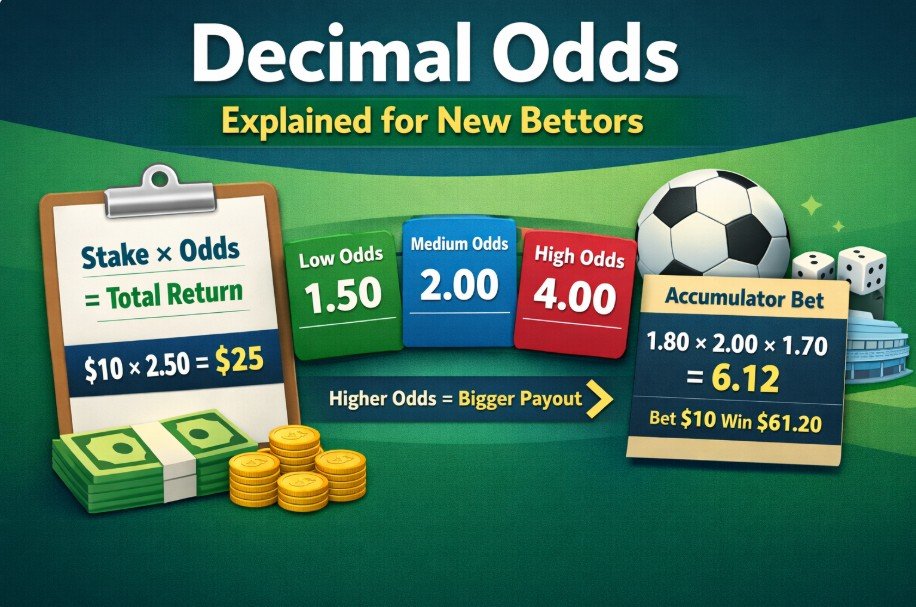
If you’re new to sports betting, one of the first things you’ll notice is the different ways odds are written. Some sites use fractions, others use American-style odds, but most modern betting platforms use decimal odds.
At first glance, they may look confusing. Numbers like 1.85, 2.40, or 3.10 don’t instantly tell you what you’ll win unless you understand how they work. The good news is that decimal odds are actually the easiest format to learn once someone explains them properly.
In this guide, we’ll break everything down in simple terms what decimal odds mean, how to calculate your returns, and how to use them smarter as a bettor.
What Are Decimal Odds?
Decimal odds show the total amount you will get back from a bet, including your stake.
That’s the key idea many beginners miss.
If you place a bet and win, decimal odds already include:
-
Your profit
-
Plus your original stake
So instead of calculating profit separately, you simply multiply your stake by the odds.
For example:
If the odds are 2.00 and you stake $10, your total return is:
10 × 2.00 = $20
That means:
-
$10 is your stake
-
$10 is your profit
Simple, clean, and easy to read.
This is why decimal odds are popular worldwide you don’t need complicated math.
How to Read Decimal Odds
Every decimal odd starts with 1.00 or higher.
-
1.00 means no profit (you only get your stake back).
-
Anything above 1.00 means profit.
-
The bigger the number, the higher the risk and reward.
Let’s look at a few examples:
| Odds | Stake | Total Return | Profit |
|---|---|---|---|
| 1.50 | $10 | $15 | $5 |
| 2.00 | $10 | $20 | $10 |
| 3.00 | $10 | $30 | $20 |
| 5.00 | $10 | $50 | $40 |
So when you see 3.00, it means you get three times your stake back if you win.
Not just profit the full amount.
The Simple Formula for Calculating Returns
To calculate your payout using decimal odds, use this formula:
Stake × Odds = Total Return
That’s it.
No extra steps.
Example:
You bet $25 on odds of 2.40.
25 × 2.40 = $60
So:
-
Total return = $60
-
Profit = $35
If you want the profit only, subtract your stake:
Total Return – Stake = Profit
What Decimal Odds Say About Probability
Odds don’t just show money. They also reflect how likely an outcome is according to the bookmaker.
You can estimate probability using this formula:
1 ÷ Odds × 100 = Implied Probability
Example:
Odds of 2.00
1 ÷ 2.00 × 100 = 50%
That means the bookmaker believes the outcome has a 50% chance of happening.
Another example:
Odds of 4.00
1 ÷ 4.00 × 100 = 25%
So higher odds mean:
-
Lower probability
-
Higher potential reward
Lower odds mean:
-
Higher probability
-
Smaller profit
Understanding this helps you decide if a bet is actually worth taking.
Low Odds vs High Odds
New bettors often wonder: should I choose low odds or high odds?
Let’s break it down.
Low Odds (1.20 – 1.70)
These are usually favorites.
Pros:
-
Higher chance of winning
-
More stable
Cons:
-
Small profit
-
One mistake ruins multiple bets
Low odds are safer but not very rewarding unless used carefully.
Medium Odds (1.80 – 2.50)
These are balanced bets.
Pros:
-
Good mix of risk and reward
-
Popular for singles and doubles
Cons:
-
Still requires discipline
Many experienced bettors focus on this range because it offers steady value.
High Odds (3.00 and above)
These are underdogs.
Pros:
-
Big payouts
-
Fun and exciting
Cons:
-
Lower chance of winning
-
Can drain bankroll fast
High odds look attractive, but without strategy, they turn into guessing.
Smart betting is not about chasing big numbers it’s about finding value, not just profit.
Decimal Odds in Accumulator Bets
Decimal odds become even more powerful when used in accumulators (also called parlays).
In accumulators, odds are multiplied together.
Example:
-
Match 1: 1.80
-
Match 2: 2.00
-
Match 3: 1.70
Combined odds:
1.80 × 2.00 × 1.70 = 6.12
If you stake $10:
10 × 6.12 = $61.20
That’s why accumulators grow fast. But remember — one losing game cancels the entire bet.
So while decimal odds make returns attractive, discipline is still important.
Common Mistakes New Bettors Make with Decimal Odds
Understanding odds is one thing. Using them properly is another. Here are mistakes beginners often make:
Chasing Big Odds
Seeing 8.00 or 12.00 looks exciting, but big odds usually mean very low probability.
Ignoring Value
Don’t just bet because odds look good. Ask: Is this outcome more likely than the odds suggest?
Overloading Accumulators
Putting 10–15 matches together increases odds but destroys your chances of winning.
Confusing Return with Profit
Remember: decimal odds show total return, not just profit.
Avoiding these small errors makes a big difference long-term.
Why Most Bookmakers Use Decimal Odds
Decimal odds are popular because they are:
-
Easy to read
-
Simple to calculate
-
Clear for beginners
-
Universal across markets
Whether you bet on football, basketball, tennis, or esports, the format stays the same. Once you understand it, you can move between platforms without confusion.
Conclusion
Decimal odds are the backbone of modern sports betting. Once you understand that they show total return, everything becomes clearer. You stop guessing and start calculating.
For new bettors, the goal isn’t just to place bets, it’s to understand what your money is actually doing before you click “stake.”
Learn how to read the numbers, calculate returns, compare probabilities, and avoid chasing unrealistic odds. Betting becomes more controlled, smarter, and less emotional.
The more comfortable you are with decimal odds, the more confident your betting decisions will be. And in the long run, confidence built on understanding always beats blind luck.